
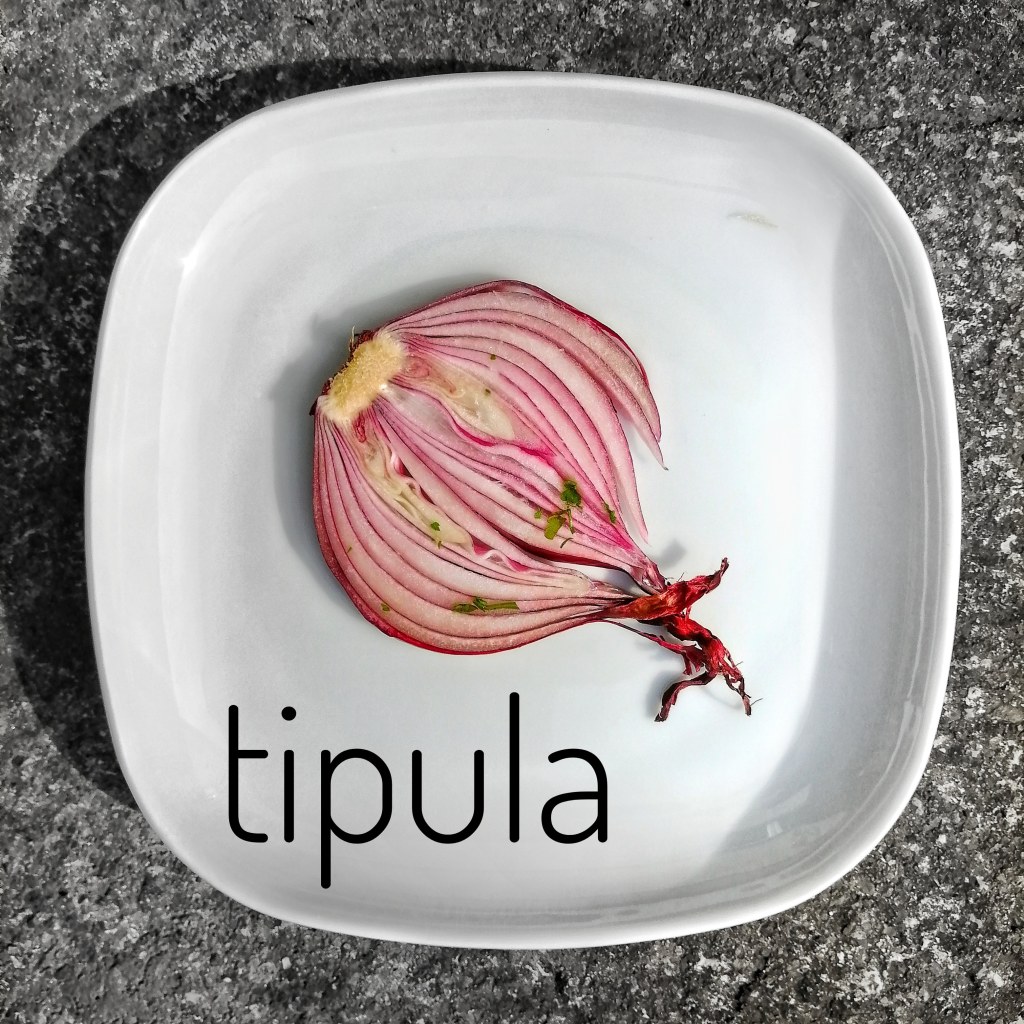
tipula = onion in Basque
The word “tipula” comes from the Latin “cepa” / v. “caepa”, or rather from its diminutive “cepulla” / v. “caepulla”, which are of unknown origin but are related with the Ancient Greek “καπια” {kapia} (onions) and the Albanian “qepë” (onion). In many European languages, not only Indo-European, just like the Basque, the word “onion” descends from Latin.
The least surprising group is Romance languages: ceapă (Romanian), cipolla (Italian), cebolla (Spanish), cebola (Portuguese).
Only in French it is “oignon” which comes from the Latin too but from a different word – “unio” (large pearl; type of onion).
Majority of Slavic languages: цыбуля {cybula} (Belarusian), cibule (Czech), cebula (Polish), cibuľa (Slovak), čebula (Slovene), cybula (Lower Sorbian), cybla (Upper Sorbian), цибуля {cybulia} (Ukrainian).
The rest borrowed from Germanic languages and Greek.
Some Baltic languages: sīpols (Latvian) and cybuļs (Latgalian).
Minority of Germanic laguages: Zwiebel (German) and sipel (West Frisian).
In other Germanic languages, they are either of Germanic origin or from the Latin “unio”. In all Celtic languages they are cognates of “onion”.
Finaly non-Indo-European languages: tipula (Basque), sipuli (Finnish), sibul (Estonian).
Photo by @lukaszdaciuk (Instagram)
#dailylogorrhoea #logorrhoea #linguistics #words #languages #focail #teangacha #słowa #języki #sanat #kielet #слова #мови #slova #jazyky #kelimeler #diller







 Daily Logorrhoea