
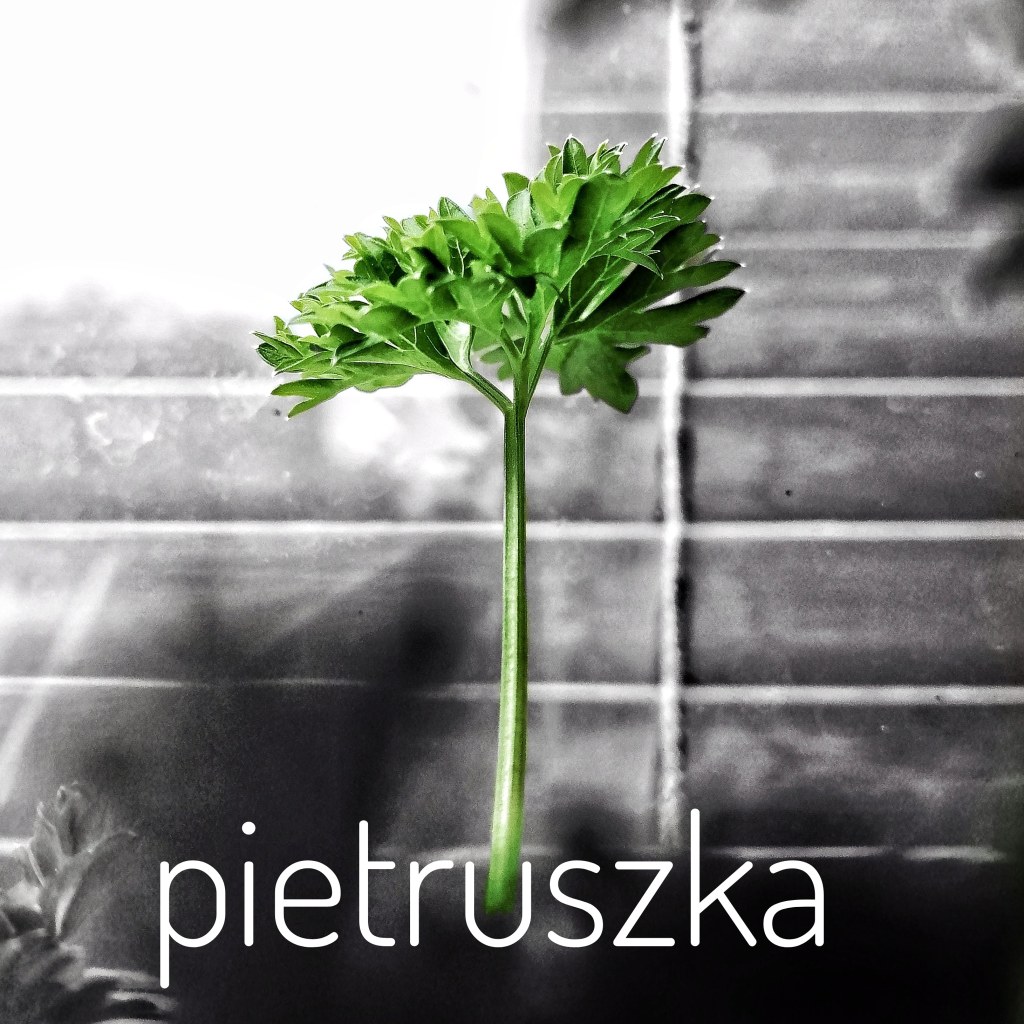
pietruszka = parsley in Polish
It always amazes me how long way words travel from one language to the other. The word “pietruszka” comes from the Greek “πετροσέλῑνον” {petrosélīnon} (parsley), combination of the words “πέτρος” {pétros} (rock, stone) and “σέλῑνον” {sélīnon} (celery) so literally from “stone celery”.
Here’s the full way:
“πετροσέλῑνον” {petrosélīnon} in Ancient Greek > petroselinum in Latin > petrosilium in Medieval Latin > pietruziele / piotruziele / piotruszka in Old Polish > pietruszka in Modern Polish
All meaning “Petroselinum crispum”. Simply “parsley” in English.
In many European languages the way was the same:
perrexil in Basque
пятрушка {pjatruška} in Belarusian
petržel, petrželka in Czech
persille in Danish & Norwegian
peterselie in Dutch
parsley in English (petersiliġe in Old English)
petersell in Estonian
persilja in Finish & Swedish
persil in French (
Petersilie in German
πετροσέλινο {petrosélino} in Greek
petrezselyem in Hungarian
steinselja in Icelandic (Latin “petro” was just replaced with the native “steinn” – stone)
peirsil in Irish
パセリ {paseri} in Japanese (hard to believe this is transformed English “parsleyc, he?)
파슬리 {paseulli} in Korean (same story like in Japanese)
pētersīlis in Latvian
petražolė in Lithuanian
pāhiri in Maori (same as Japanese & Korean)
pătrunjel in Romanian
петрушка {petruška} in Russian & Ukrainian
pairseil, pearsal in Scottish
petržlen in Slovak
peteršilj in Slovene
perejil in Spanish
Photo by @lukaszdaciuk (Instagram)
#dailylogorrhoea #logorrhoea #linguistics #words #languages #focail #teangacha #słowa #języki #sanat #kielet #слова #мови #slova #jazyky #kelimeler #diller
 Daily Logorrhoea