
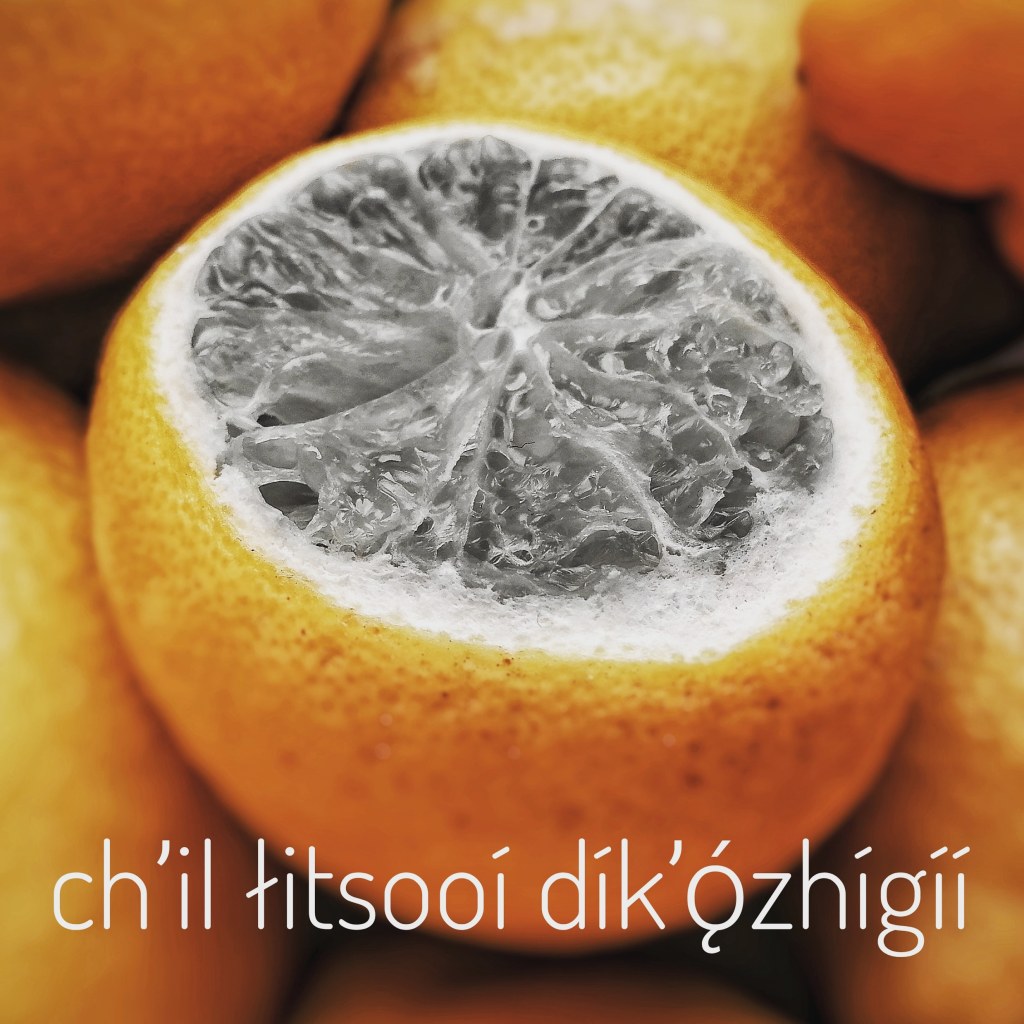
chʼil łitsooí díkʼǫ́zhígíí = lemon in Navajo
Diné bizaad (or Navajo as we know it) is a fascinating Athabaskan language that never fails to amaze me with its creativity and logic.
I am not a linguist so I divide languages unprofessionally into three groups:
1) one-idea-one-word group – languages like English, Finnish, Irish
2) many-ideas-one-word group – languages like Greenlandic
3) one-idea-many-words – languages like Navajo
So the idea called “lemon” is described in many words:
chʼil łitsooí díkʼǫ́zhígíí = a plant that is yellow and that is sour
chʼil = plant
łitso = it is yellow
díkʼǫ́ǫ́zh = it is sour
So how do you say “lime”? You just replace “łitso” (it is yellow) with “dootłʼizh” (it is green).
chʼil dootłʼizhí díkʼǫ́zhígíí” = a plant that is green and that is sour
What about “orange”? Think about the colour.
łitsxo = it is orange (about colour)
chʼil łitsxooí = a plant that is orange
And “grapefruit”? Simply add “nitsxaa” (it is really big) to the “orange”
chʼil łitsxooí nitsxaaígíí = a plant that is orange and that is really big
Photo by @lukaszdaciuk (Instagram)
#dailylogorrhoea #logorrhoea #linguistics #words #languages #focail #teangacha #słowa #języki #sanat #kielet #слова #мови #slova #jazyky #kelimeler #diller
 Daily Logorrhoea